What is a custom-trained AI agent?
Updated
 Custom AI agents
A custom-trained AI agent is an assistant built around your business knowledge and a defined job. The useful question is what it can reliably help people do with that knowledge.
What does “custom-trained” mean?
In a business project, the phrase often means an assistant tailored to your information and processes. It does not always mean training a new model. The implementation may combine a model with instructions, access to reviewed documents and connections to permitted actions. Fine-tuning may be considered when the task calls for it; it is not automatically required.
Ask your implementation partner to explain which approach they propose and why. “It knows our company” should translate into specific sources it can use, questions it can answer and limits it must respect.
Where does a business-specific agent help?
A customer-support assistant could answer product questions using approved documentation and collect the details needed for a support ticket. An internal assistant could help staff find a procedure or policy. A sales assistant could explain services and ask relevant qualification questions before passing the enquiry to the team.
For example, a travel business might use an assistant to collect dates, traveller preferences and budget. That is different from issuing a ticket or promising a refund. Those actions need the appropriate system connection and authority.
Knowledge, instructions and actions do different jobs
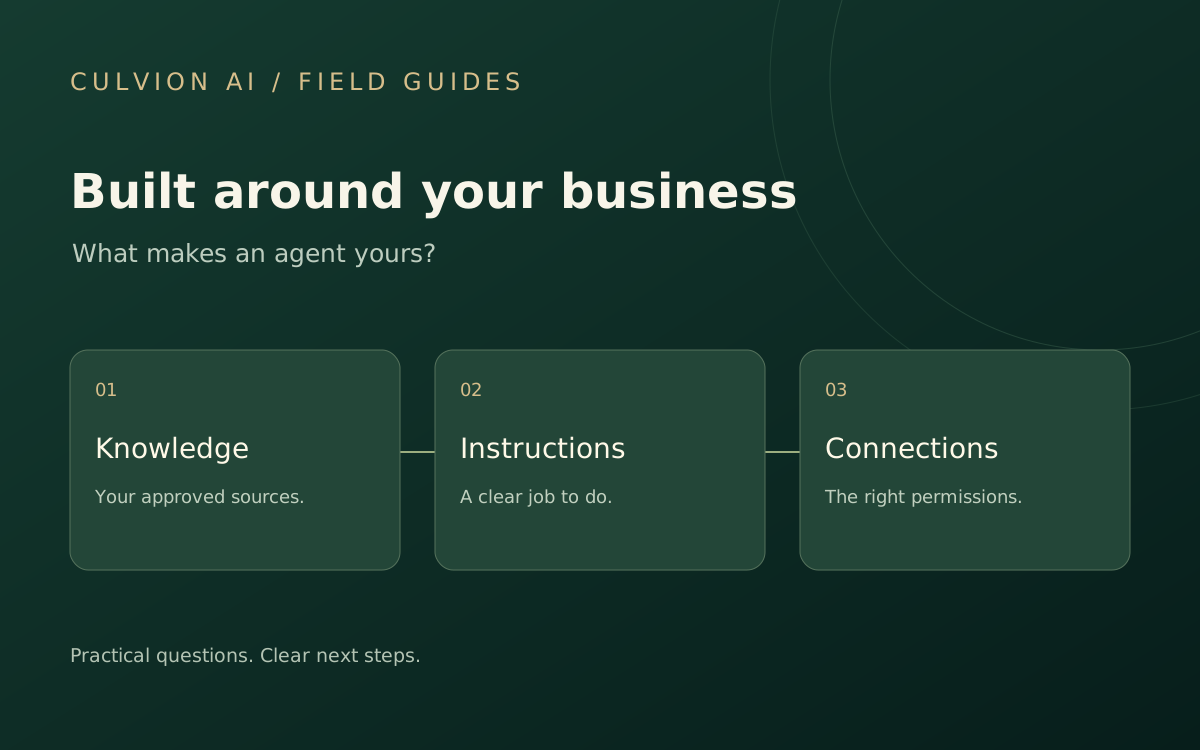
- Knowledge supplies business facts: product details, service areas, policies and current pricing.
- Instructions describe the job: how to answer, what to ask and when to involve a person.
- Actions connect the assistant to work: looking up a record, creating a task or checking availability.
Keeping these responsibilities clear makes updates easier. A changed policy belongs in the reviewed knowledge source. A new handoff rule belongs in the workflow. Permission to edit a record must be enforced by the connection, not merely requested in a prompt.
What should you prepare?
Gather a small, current set of useful material. Include your most common questions, approved answers, service details and examples of requests that need a person. Remove outdated versions and identify who can approve changes.
List the systems involved and the access the assistant would need. If you have customer data, agree what can be used, where it will be processed and how long it is retained before sharing it. See our security information and discuss requirements for your specific deployment.
How do you know it is ready?
Test ordinary requests, missing information and questions outside the available knowledge. Ask the same question in different ways. Verify important answers against the source and check that restricted actions are blocked.
A useful assistant should admit when the information is missing, collect the relevant context and offer the agreed next step. It should not invent a price, booking or policy to keep the conversation moving. Keep a record of failures and repeat those cases after changes.
The NIST AI Risk Management Framework is useful broader reading for organisations planning how to govern, evaluate and manage AI risks. It does not certify an individual assistant or replace testing your workflow.
Can the same approach work over voice?
Yes, business knowledge and permitted actions can support a voice interface as well as a text interface. Voice adds its own requirements: speech recognition, pronunciation, language switching, interruptions and the pause before an answer. Test those on the channel your customers will actually use.
Explore our custom-trained agent service, custom AI software or Voice Agent Studio depending on the experience you want to build.
Start your brief with one sentence: “Help this person complete this task using these sources.” We can work through the rest in a project consultation.