How to test an AI voice agent before launch
Updated
 Voice agent playbook
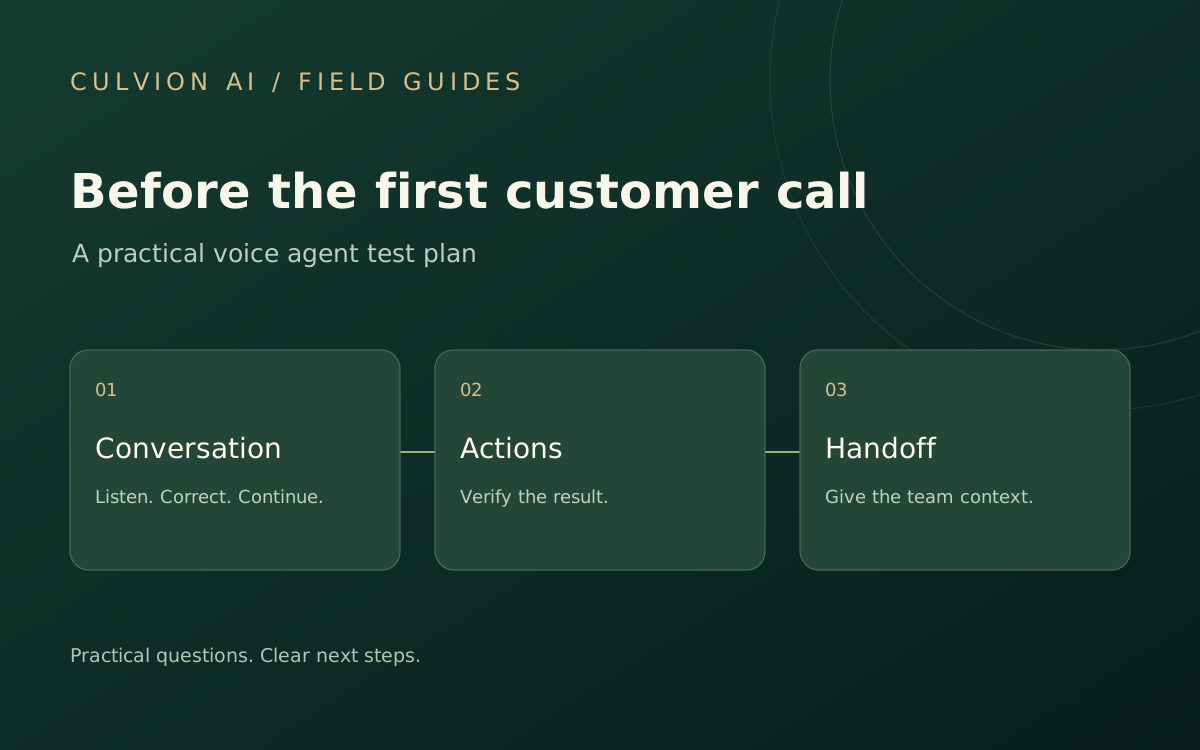
A good voice-agent demo is a starting point. Before customers use it, check the conversation, the action it takes and what your team receives afterwards.
What should you test first?
Start with a single job. For a skin clinic, that might be collecting consultation requests while the front desk is busy. For a property team, it might be qualifying an enquiry and recording a preferred viewing time. Write down what a successful call leaves behind: an accurate request, the agreed next step and an owner.
Then prepare a small set of fictional callers. Include an easy enquiry, an unclear request and a question the agent cannot answer. Keep these scenarios fixed when comparing versions so an improvement on one call does not hide a failure on another.
Run a conversation, not a perfect script
Ask a question, change your mind and interrupt the answer. Say “Tuesday—actually, Thursday afternoon.” Give a name the recogniser might mishear. Ask where the call is coming from. End one call with “I’m busy, we’ll speak later” and use “okay, thanks” halfway through another.
- Does the agent answer the question before starting another pitch?
- Does it remember details without repeatedly asking for them?
- Can it distinguish an acknowledgement from a goodbye?
- When interrupted, does it listen and respond to the correction?
- Does the call end once, with a clear closing?
Repeat the exercise in the languages your customers use, including natural language switches. A Hindi-speaking caller may still use English words for “appointment”, “budget” or “follow-up”. Test that conversation rather than a translated English script.
Check the action after the conversation
An agent saying “I’ve booked it” is not proof of a booking. Inspect the calendar or lead record. Confirm that the time, name and contact details match what was supplied, and that a rejected action is explained accurately.
For a hotel example, distinguish a room enquiry from a confirmed reservation. For a clinic, keep administrative requests separate from clinical advice. If live availability is not connected, the agent should collect a preference for the team to confirm.
Test a refusal to share contact details, an already-submitted enquiry and an unavailable integration. Check that neither invented details nor duplicate requests reach your team.
Measure the pauses callers actually hear
Measure from the end of the caller’s speech to the first audible answer. Keep that separate from the model’s first-token time. Speech recognition, turn detection, model generation, speech synthesis and the network all contribute to the experience.
Try a quiet room, ordinary background noise and a mobile connection. Record typical and slow responses rather than reporting only the best call. LiveKit’s turn-handling documentation explains why deciding when a person has finished and handling interruptions are separate parts of the conversation.
Test busy periods and outbound follow-ups
Use an agreed test environment to check simultaneous calls, a full queue and recovery when a line becomes free. The visitor’s status should describe what is really happening. An unanswered or failed dial attempt should not appear as a completed conversation.
For outbound workflows, check the eligible lead source, calling schedule, retry rules and how a request not to be contacted stops further follow-up. Verify capacity with your carrier and implementation team; a convincing demo alone does not establish production capacity.
Decide what must pass before launch
Keep a simple review sheet: scenario, expected behaviour, observed result and next action. Block launch for false booking confirmations, incorrect contact records or failed stop requests. Review slower responses and awkward wording separately, with a target and a named owner.
After fixes, repeat the failed scenario and a normal call. Begin with a limited pilot and review real outcomes before increasing volume. Our Voice Agent Studio helps you explore sample roles; your business workflow still needs its own acceptance checks.
Bring a few realistic call scenarios to a guided demo. We can discuss the knowledge, connections and pilot your business needs.