What should an AI voice agent budget include?
Updated
 Buying guide
An AI voice agent budget needs more than a price per minute. Start with the calls you want handled, then compare usage, setup and support on the same basis.
Separate the four parts of the cost
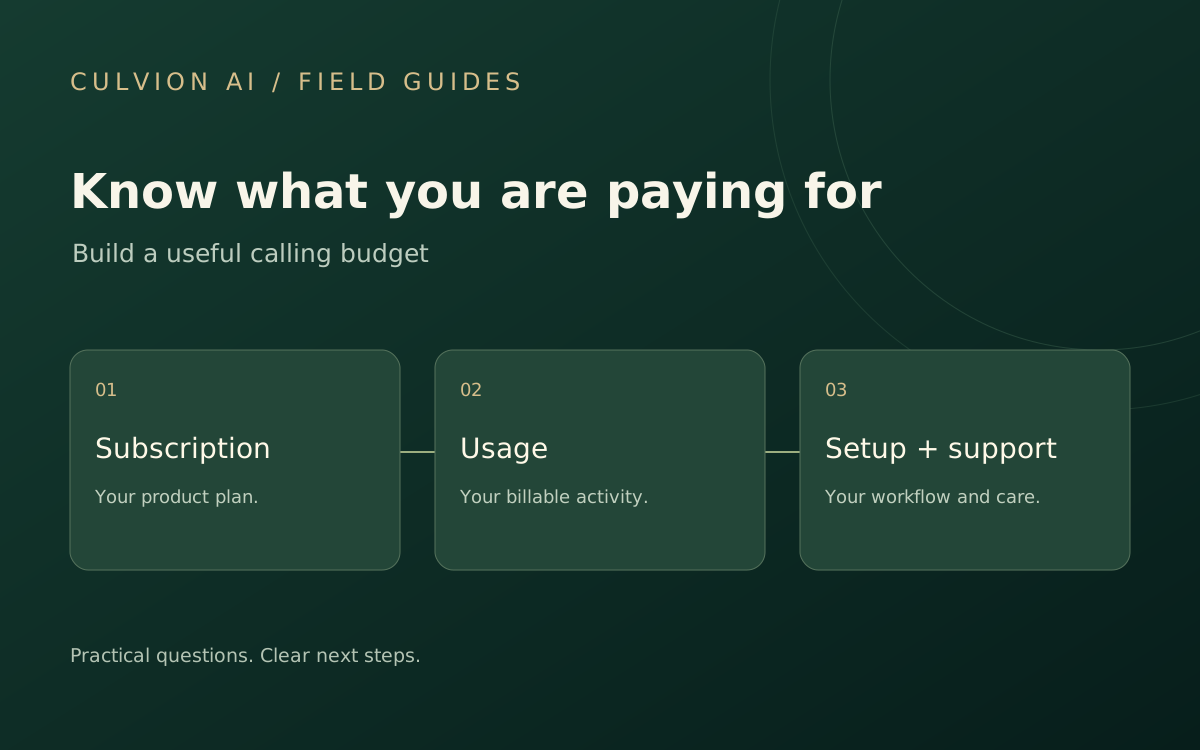
A useful quote separates the subscription, metered usage, implementation and ongoing support. Ask which items are included, which vary with volume and which are charged once. Compare equivalent scopes: a browser conversation demo and a production phone workflow do not necessarily have the same costs.
- Subscription: the product plan, seats or included capabilities.
- Usage: billable calling time and any separately charged phone or provider usage.
- Implementation: business knowledge, conversation design, numbers, routing and integrations.
- Support: agreed monitoring, updates and maintenance after launch.
Use the current Culvion pricing page for published plans. For a custom deployment, request a written quote that identifies currency, taxes, allowances and overage terms.
Estimate minutes before comparing minute rates
For illustration, suppose a business expects 1,000 answered calls a month averaging three minutes. That gives 3,000 conversation minutes. If a hypothetical quote charges ₹5 per billable minute, the usage component would be ₹15,000 before other charges. This is arithmetic, not a Culvion quote or a forecast of your results.
Repeat the estimate for a quieter month and a busy month. Ask when billing begins, how partial minutes are rounded and how unsuccessful attempts, ringing, hold time and transfers are treated. Those definitions can change the total even when two headline rates look the same.
Inbound and outbound need different assumptions
For inbound calls, estimate the calls you want the agent to receive, their duration and your busiest periods. A hotel’s reservation enquiries may arrive outside front-desk hours; a clinic may have a concentrated rush before opening.
For outbound work, estimate eligible contacts, answer rates, retries and follow-up length separately. A thousand dial attempts is not a thousand conversations. For a real-estate team, a short qualification call may also lead to a longer discussion that a person should handle.
These estimates are planning inputs. Use your own call records where available and replace assumptions with pilot data.
Capacity is different from total minutes
A monthly total does not tell you how many people can call at once. Ask about simultaneous call capacity, how quickly new calls can start and what happens when demand exceeds that capacity. Confirm queue limits and the message callers or website visitors see while waiting.
There is little value in paying for unused capacity, but a plan that cannot cover a short daily peak may also be a poor fit. Discuss the busy interval, not just the monthly average.
Compare the cost of a useful outcome
Look at cost per correctly completed enquiry, qualified lead or confirmed attendance, depending on the job. Include the staff time needed to review records and handle exceptions. A cheap minute is not helpful if the request must be repeated to a person.
When comparing with a human team, use your actual staffing, supervision and software costs alongside the quality and judgement required. Avoid assuming every caller can be automated or that one industry’s savings will apply to another.
What to send when asking for a quote
Share your industry, inbound and outbound use cases, estimated volume, languages, peak demand and existing systems. Identify which actions need a real integration—for example checking availability versus collecting a preferred appointment time.
Ask for a pilot scope, acceptance criteria, support responsibilities and a clear explanation of what happens if usage grows. For a broader assistant or application, see our custom AI services.
Have rough call volumes? Use the pricing page as a starting point, then talk through your workflow for a scoped estimate.